---
title: "Snowflake x CACI: MLOps & Data Foundations eBook"
description: Learn why AI initiatives stall and what it takes to scale AI successfully. Explore the role of trusted data, observability and MLOps in driving AI maturity
image: https://info.caci.co.uk/hubfs/Mockup-4.png
---
[Skip to content](https://info.caci.co.uk/mlops-data-foundations-ebook#l-main-content)
[](https://info.caci.co.uk/?hsLang=en-gb)
%201.png?width=475&height=108&name=Snowflake_Logo_white%20(1)%201.png "Snowflake_Logo_white (1) 1")
[Scale AI with confidence](https://info.caci.co.uk/mlops-data-foundations-ebook#form)
# eBook From AI pilots to production-ready AI
Why scalable AI starts with trusted data foundations & MLOps
In collaboration with Snowflake
[Get your copy now](https://info.caci.co.uk/mlops-data-foundations-ebook#form)
# eBook From AI pilots to production-ready AI
Why scalable AI starts with trusted data foundations & MLOps
In collaboration with Snowflake
[](https://info.caci.co.uk/mlops-data-foundations-ebook#form)
[Get your copy now](https://info.caci.co.uk/mlops-data-foundations-ebook#form)
The challenge for most enterprise organisations now is turning successful AI pilots into capabilities that can be trusted, governed and scaled across the business.
Written by Jonathan Ede, Director of Technology Solutions Strategy at CACI, in collaboration with Snowflake, this eBook explores why AI initiatives often stall after the proof-of-concept stage and what organisations need to do differently to achieve production-ready AI. Drawing on real-world experience helping organisations modernise data platforms and operationalise machine learning, it outlines the foundations required to build AI that delivers measurable business value at scale.
#### The foundations of scalable AI
Successful AI programmes are built on more than models. They require the right data, governance and operational processes to ensure AI remains reliable, secure and cost-effective as adoption grows.

###### Trusted data: Reliable AI starts with governed, accessible data that teams can trust and reuse across multiple use cases.

###### Built-in governance: Security, compliance and accountability must be embedded from the outset, not added as an afterthought.

###### Observability: Measure performance, usage and value to ensure AI remains reliable and aligned to business goals.
## Is this eBook for you?
Whether you're leading technology strategy, managing data platforms or shaping business transformation, this eBook will help you understand what separates successful AI programmes from those that never move beyond pilot stage.
You'll learn how organisations can:
1. Scale AI without losing control of cost, risk or governance.
2. Build trust in AI outputs through strong data foundations.
3. Create repeatable processes for deploying and managing models.
4. Improve visibility into AI performance, usage and business value.
5. Turn AI from isolated experiments into an operational business capability.
## About the author: Jonathan Ede
Jonathan Ede is a data, cloud and AI technology leader who heads CACI's DataTech and AI Architecture practice.
With deep expertise across data platforms, analytics architecture, software engineering and AI, he helps organisations build the foundations required to scale AI safely, effectively and at pace.
Jonathan advises senior technology leaders on data strategy, AI adoption and technology transformation, helping organisations move beyond experimentation and turn AI into a trusted, production-ready business capability.
He has led complex transformation programmes from strategy and architecture through to delivery and long-term operational success.
[Explore the insights](https://info.caci.co.uk/mlops-data-foundations-ebook#form)


## About the author: Jonathan Ede
Jonathan Ede is a data, cloud and AI technology leader who heads CACI's DataTech and AI Architecture practice.
With deep expertise across data platforms, analytics architecture, software engineering and AI, he helps organisations build the foundations required to scale AI safely, effectively and at pace.
Jonathan advises senior technology leaders on data strategy, AI adoption and technology transformation, helping organisations move beyond experimentation and turn AI into a trusted, production-ready business capability.
He has led complex transformation programmes from strategy and architecture through to delivery and long-term operational success.
[Explore the insights](https://info.caci.co.uk/mlops-data-foundations-ebook#form)
## Inside the guide:
## Why AI programmes stall before they scale
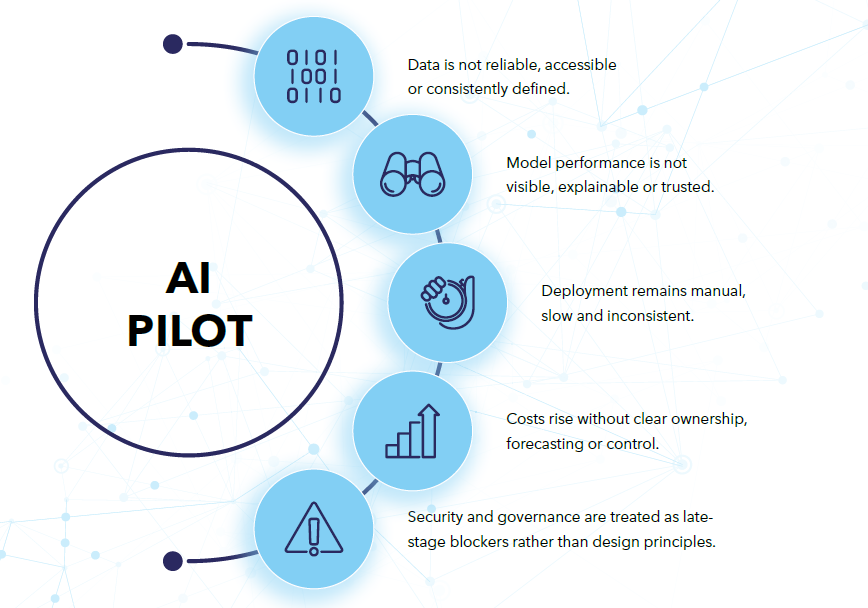
Most organisations are not short on AI ambition. The challenge is that their data, controls and operating models were not designed for AI at scale.
That becomes visible when pilots move into production.
As business units introduce their own AI tools and workflows, they often rely on the same underlying data and infrastructure. Without strong foundations, that creates duplication, inconsistent outputs and increasing operational risk.
This is where many AI programmes stall. Not because the models fail, but because the environment around them is not built to support production-scale AI.
---
## The hidden enablers behind scaling AI
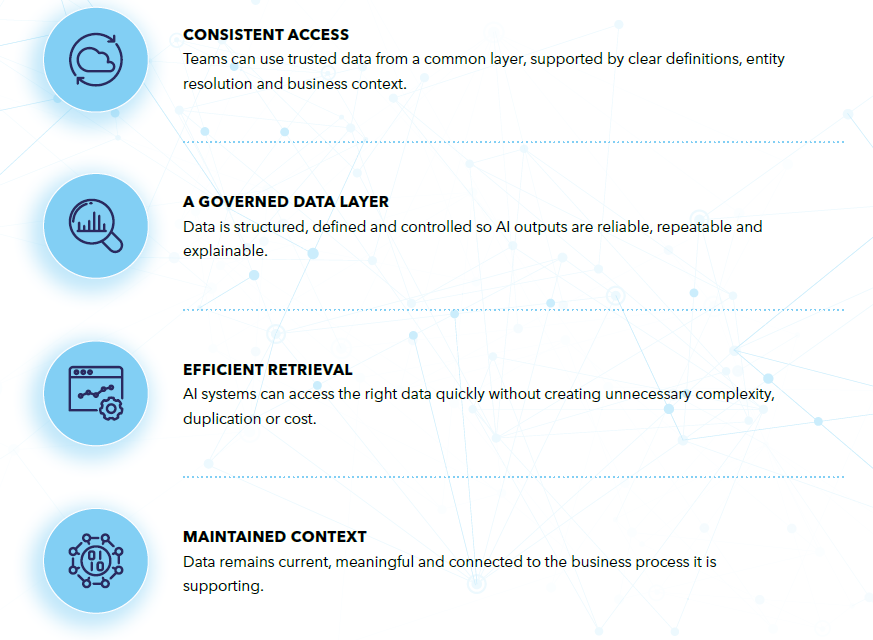
Scaling AI starts with making data usable, consistent and controlled across the organisation. A unified data platform becomes critical because it connects governed data, scalable compute, secure access and operational ML workflows in one environment.
When data, ML and business teams operate across fragmented tools, pipelines and environments, duplication increases, governance weakens and costs become harder to control. The goal is not to centralise every decision, but to create common foundations that make AI easier to scale safely.
---
## The key differences in AI pilots vs. AI in production
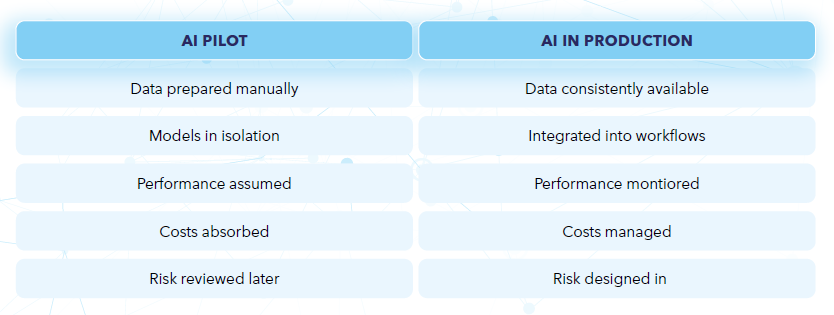
In the early stages, AI is relatively forgiving. A small team can build a model, prepare the data manually and deploy it in isolation. If something breaks, it is visible and fixable.
At scale, particularly in a federated environment, that approach breaks down. More models, users, data sources and workflows create complexity that cannot be managed through manual effort. AI is no longer something a team builds. It becomes something the organisation has to run. That changes the problem completely.
## Discover what it takes to scale AI successfully:
---

© 2026 CACI Limited. All rights reserved
CACI Limited (Registered number 01649776) is registered in England and Wales with its registered office at CACI House, Avonmore Road, London, W14 8TS.
**Terms of use:**
[Legal](https://www.caci.co.uk/legal/)
[Privacy](https://www.caci.co.uk/data-privacy/)
[Cookies Policy](https://www.caci.co.uk/data-privacy/cookie-policy/)
**Follow us:**